WASHINGTON – Today, U.S. Senator Deb Fischer (R-NE), a senior member of the Senate Armed Services Committee, spoke on the Senate floor to urge swift passage of the National Defense Authorization Act (NDAA) for Fiscal Year 2027.
As chair of the Strategic Forces Subcommittee, Fischer emphasized the importance of maintaining the credibility of our nuclear deterrent at a time when the United States faces two peer nuclear competitors simultaneously for the first time in history.
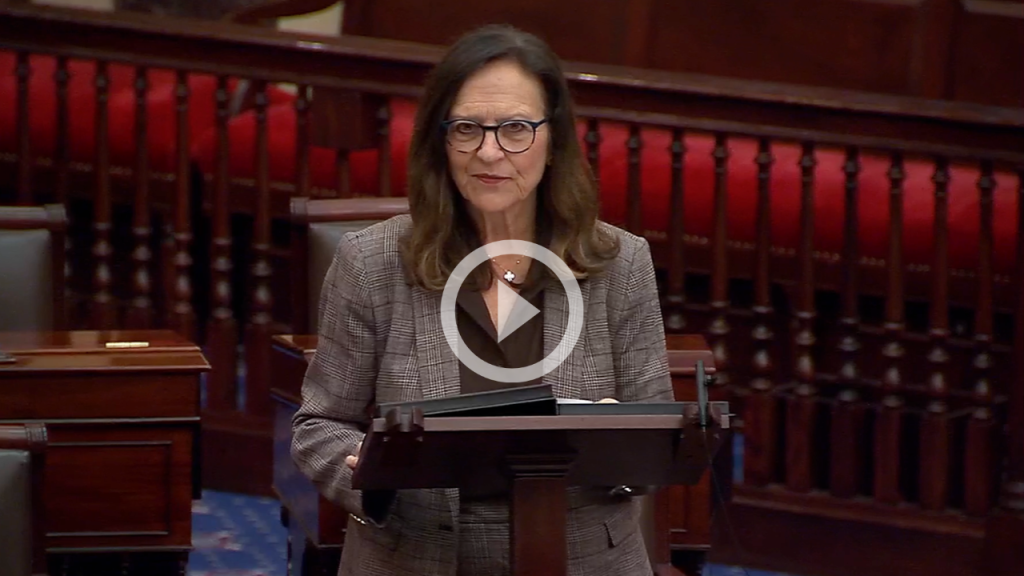
Click the image above to watch a video of Fischer’s remarks.
Click here to download video.
Fischer’s Senate floor speech as prepared for delivery:
M. President,
America faces the most perilous threat environment since World War II. We face an axis of aggressors — China, Russia, Iran, and North Korea. Competition with these adversaries will determine whether the 21st century will be led by America or by an authoritarian regime.
That is why we must be ready to deter and win any conflict.
Every year, the Senate Armed Services Committee works together to build a strong defense policy bill – the NDAA – to meet the current threat environment. We have done so successfully for 66 years in a row. And I am proud that we have consistently produced a bipartisan product.
Given the stakes, you would think that every senator – in both parties – would see the urgency this moment demands. You would think every senator would want to move the NDAA swiftly.
Back in July, we had an opportunity to do just that. We could have considered additional amendments from senators that may have improved this bill. I certainly wanted to take up amendments and have an open process on the Senate floor. Instead, Senator Schumer blocked the NDAA from moving forward.
M. President, this is not a partisan bill.
The manager’s package alone included amendments from members on both sides of the aisle. 38 from Republicans. 38 from Democrats. And 10 crafted on a bipartisan basis.
It was disappointing to see Senator Schumer put politics above our national security. Democrats prevented their own members from offering amendments on the issues those members, and their constituents care about.
I chair the Strategic Forces subcommittee, and our portion of this year’s NDAA addressed 184 requests from senators on both sides of the aisle. I believe a full floor process would have strengthened the Senate’s bill. Nonetheless, I am optimistic that we will soon reach agreement with the House on a final NDAA for this fiscal year.
Thankfully, we will soon have another opportunity to consider this year’s NDAA. It is time to put our country first. It is time to prepare to debate and advance a bill that our national security depends on.
I emphasize this because, for the first time in history, the United States faces two peer nuclear adversaries at once.
Russia has already modernized most of its nuclear forces. It continues to field new delivery systems and has long maintained an advantage in tactical nuclear weapons. That imbalance presents real challenges for deterrence.
China is expanding its nuclear arsenal at a breathtaking pace – consistently exceeding U.S. estimates of their progress. China is building new missile silos, increasing its warhead stockpile, and rapidly developing the full range of nuclear delivery systems.
This is not the strategic environment we planned for.
The structure of our nuclear forces today was determined during a very different geopolitical moment. At that time, many policymakers believed Russia might become a cooperative partner and that China would remain a more limited strategic competitor.
Those assumptions have been proven wrong. Russia has made clear its disdain for partnership. Instead, it prioritizes challenging the West. China is now an increasingly capable strategic rival. President Xi is working with our persistent adversaries to share weapons, share technology, share resources, and strategic objectives.
Together, they are working to challenge American power, undermine stability, and threaten international security.
That reality should inject urgency into everything we do. That involves force modernization, industrial capacity, alliance coordination, and modernizing the bedrock of our national security: our nuclear triad. It is more important than ever that we invest in our deterrence, our missile defense systems, and support our allies.
This year’s Senate NDAA does exactly that. And I am hopeful that my provisions to maintain the credibility of our nuclear deterrent will be retained in the final version.
Given these threats, the president should have a full array of options to respond to limited nuclear strikes and deter our adversaries from employing an “escalate-to-deescalate” strategy.
That is why I fought to authorize over $250 million dollars for the nuclear-armed sea-launched cruise missile. I was glad to see this year’s Defense Appropriations Act adequately fund this program at the level it requires.
You know authorizing these systems and capabilities in the NDAA is only the first step. Then, we must actually appropriate the funds to get these programs up and running.
It is why I authorized the development of two additional theater-range nuclear capabilities. Without them, the United States risks ceding strategic advantages to our adversaries in regional conflicts.
A modern, credible nuclear deterrent means little, though, without the president’s ability to command, control, and communicate with those forces. So, we must modernize our NC3 systems as well. This bill would push the Air Force to deliver an acquisition strategy for the Airborne Command Post — a capability we need to command and control our nuclear forces in a crisis.
China and Russia are also expanding the warfighting domain into space. Our adversaries are fielding an array of weapons that can blind, jam, disable, or destroy our satellites. Russia is developing satellites to carry nuclear weapons into space.
This threat is serious. We must build resilient satellite constellations that can survive attack. We must improve our ability to detect and track hostile activity in orbit. We must develop defensive and offensive capabilities.
Adversaries cannot believe they will ever have an advantage from space. All of this requires substantial investment.
Homeland defense is another priority reflected in this bill. Our adversaries have systems capable of holding U.S.-based assets at risk. The more vulnerable our homeland is, the harder it becomes to employ power during a conflict.
And that is what brings us to Golden Dome. The United States needs a stronger homeland missile defense system.
In 2024, I introduced legislation requiring the development of a comprehensive integrated air and missile defense architecture. My bill was enacted into law through the NDAA two years ago by a vote of 85 to 14. It was Congress who established this program, in 2024.
When President Trump began his second term in 2025, he brought the attention to this very real need by establishing what he named Golden Dome for America. His focus here is welcome, because the threat is real, and it is growing.
China has built the world’s most advanced hypersonic arsenal. And China has historically run up to 20 times more test flights than we have. It should alarm every American that our adversaries are racing ahead with these weapons.
Today, a limited number of ground-based interceptors in Alaska and California protect us against an ICBM attack from a rogue nation — but they were never built to stop advanced cruise missiles or hypersonics from our peer adversaries: China and Russia.
This is another reason why Golden Dome is essential.
As chair of the Strategic Forces Subcommittee, I’m working closely with General Guetlein and Department leadership as they finalize the design, the schedule, and the long-term funding needs.
We provided over $24 billion as a down payment last year. And I used this year’s NDAA to help keep the program on track. But this will require sustained investment for years to come.
Taken together, these provisions send a clear message: America’s capabilities remain strong and credible. Again, passing the NDAA is only a part of protecting our national security. Then, we must fund these programs to get the job done.
A CR does not just pause needed security programs. A CR sets them back and puts us even further behind our adversaries. And they know that.
We cannot simply talk about national security. We have to put the money behind all of our big talk.
M. President, we face serious challenges as we navigate our adversaries’ growing ambitions on land, across the seas, in the skies, and into outer space.
But with strong leadership and sustained investment, we can protect our country and advance our prosperity. We must strengthen our military and signal that America is prepared to meet the moment.
I urge my colleagues on both sides of the aisle to put aside partisan gamesmanship. Let’s pass the NDAA before the end of the year.
Thank you, M. President.